
In February 2020, in my role as Director of Communications for Global Affairs at UC Davis, I presented on communications resources and strategies at the Association of International Education Administrators (AIEA) Annual Conference in Washington, D.C., alongside Gale Lynch, Senior Director of Global Engagement and International Support Services at The New School, and Rick Lee, Director of Global Programs and Partnerships of Rutgers Global at Rutgers, The State University of New Jersey.
With the theme of the conference being “Rethinking Comprehensive Internationalization for a Global Generation,” our presentation objectives were to show the importance of communicating value internally and externally, while sharing tips and resources for tailoring communications planning to advance comprehensive institutional goals as well as ways for Senior International Officers (SIOs) and other professionals to rethink how they can be change agents through communications.
The exciting part was presenting on this topic to a packed conference room; the challenging part was fitting this all into a 30-minute presentation with another 30 minutes allotted for questions and discussions. Here are some of the key items on which I presented.
Why is communications planning needed?
It often seems like an easy choice to act fast, dive right into projects, or tackle requests to check them off your list. But communications planning—as simple or as complex as needed—can save time and add significant value in the long-run.
Communications planning…
- Evaluates the field and environment
- Defines your audience and narrows your scope of efforts
- Sets goals and objectives accordingly
- Creates a framework to build upon over time
- Ensures coordinated efforts and puts everyone in the organization “on the same page”
- Amplifies organizational goals and communicates value
What does an example communications plan outline look like?
Communications plans can come in many forms and can cover various aspects of communications and planning, based on organizational projects, goals, or initiatives. I find the below outline generally works well for getting started.
- Purpose
- Timeline
- Executive Summary
- Environmental Scan
- Internal Audit (including SWOT Analysis and Content Calendar)
- Goals and Objectives
- Messaging
- Assessment and Future Planning
Often overlooked pieces are the environmental scan and internal audit. Knowing the internal environment is just as important as understanding the external one. Realizing organizational structure, organizational culture, approval processes, financial and human resources, technology available, and systems already in place is key in then determining how to shape strategies, goals, and objectives.
Another way to approach planning—especially for shorter-term projects or initiatives—is to answer some key questions:
- Who are your audiences?
- What are key strategies and objectives? What is your key messaging?
- When is the ideal timing?
- Where are your main channels?
- Why do you need a plan? What’s the purpose and impact?
- How will you implement and sustain the plan?
How do communications plan goals relate to organizational or strategic plan goals?
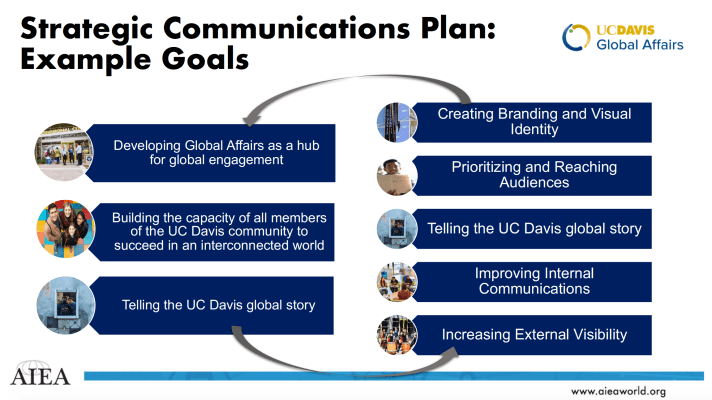
Communications goals should always tie back to larger organizational goals or strategies or initiatives. For example, the communications team goals I developed within Global Affairs at UC Davis were created based on larger organizational strategic plan goals. The two sets of goals feed into each other constantly.
What are some examples of communications plan goals coming to life?
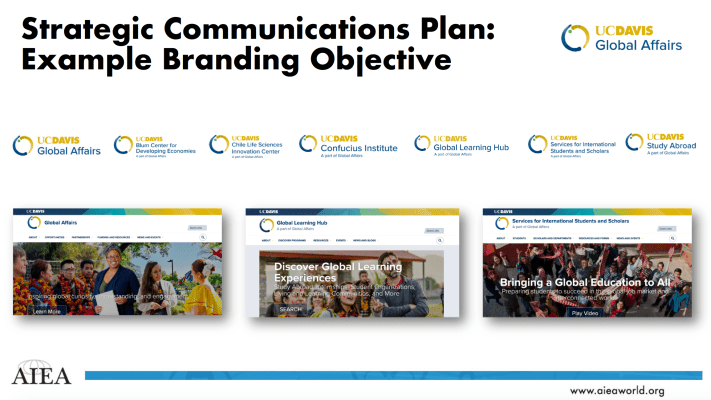
One of our goals was to “Create Branding and Visual Identity” because there was not yet unified branding for units within Global Affairs and there was not yet a clear overall identity for Global Affairs—a common challenge at comprehensive international offices around the world.
After research, focus groups, surveys, and coordination with Global Affairs leadership, staff members, and with the central campus marketing team, we developed identity and brand guidelines specific to Global Affairs, templates and other resources, and, most notably, a new logo system (examples of which are shown below).
Another, more ongoing, focus goal within our communications plan is to “Tell the UC Davis Global Story.” To provide a framework for this goal, I led the creation of a storytelling strategy, which includes several themes, content types, audience types, and goals for storytelling and content creation. For storytelling, in general, I find these five guiding principles important, particularly with limited resources.
- Focus stories: align them with overall institutional strategies and organizational goals
- Communicate value: tell real stories, with real outcomes
- Tell your global story in multiple ways: determine and focus on highly-visible channels and provide trainings and tools for experts and thought leaders in telling your story (e.g. blogging, op-eds, interviews)
- Repurpose content: remember some stories, with minimal tweaking in format or content, meet many needs
- Partner: reach common goals, share resources, and better communicate value

What are some tips and tricks for communicating value?
Understanding resources are usually limited, time is usually short, and goals are usually complex, here are four of my tips for engaging in communications planning and in communicating value, whether internally in your organization or externally with outside audiences.
- Find what already exists: determine existing communications resources and outlets before creating your own
- Know your opportunities: determine strengths, weaknesses, opportunities, and threats for more effective communications
- Partnerships are key: share resources to reach common goals (and expanded audiences)
- We’re all communicators: be ready to share your stories of impact with others!
Final thoughts…
In all of this, I was able to reflect on a few of my favorite parts of being a communications director: I get to use my analytical skills, creativity, and ability to connect with people as I serve as an ambassador, an advocate, and a storyteller for a global organization.


 Bonnie C. Shea